lynq.ing lynq.ing

Talks · SFSCon 2026 · · Bolzano

Generative AI in a Truly Sovereign Digital Europe

A field guide to real sovereignty for LLMs

What actually makes an LLM service sovereign, and the questions to ask your AI vendor before you sign.

Download PDF 14 slides · 136 KB

Takeaways

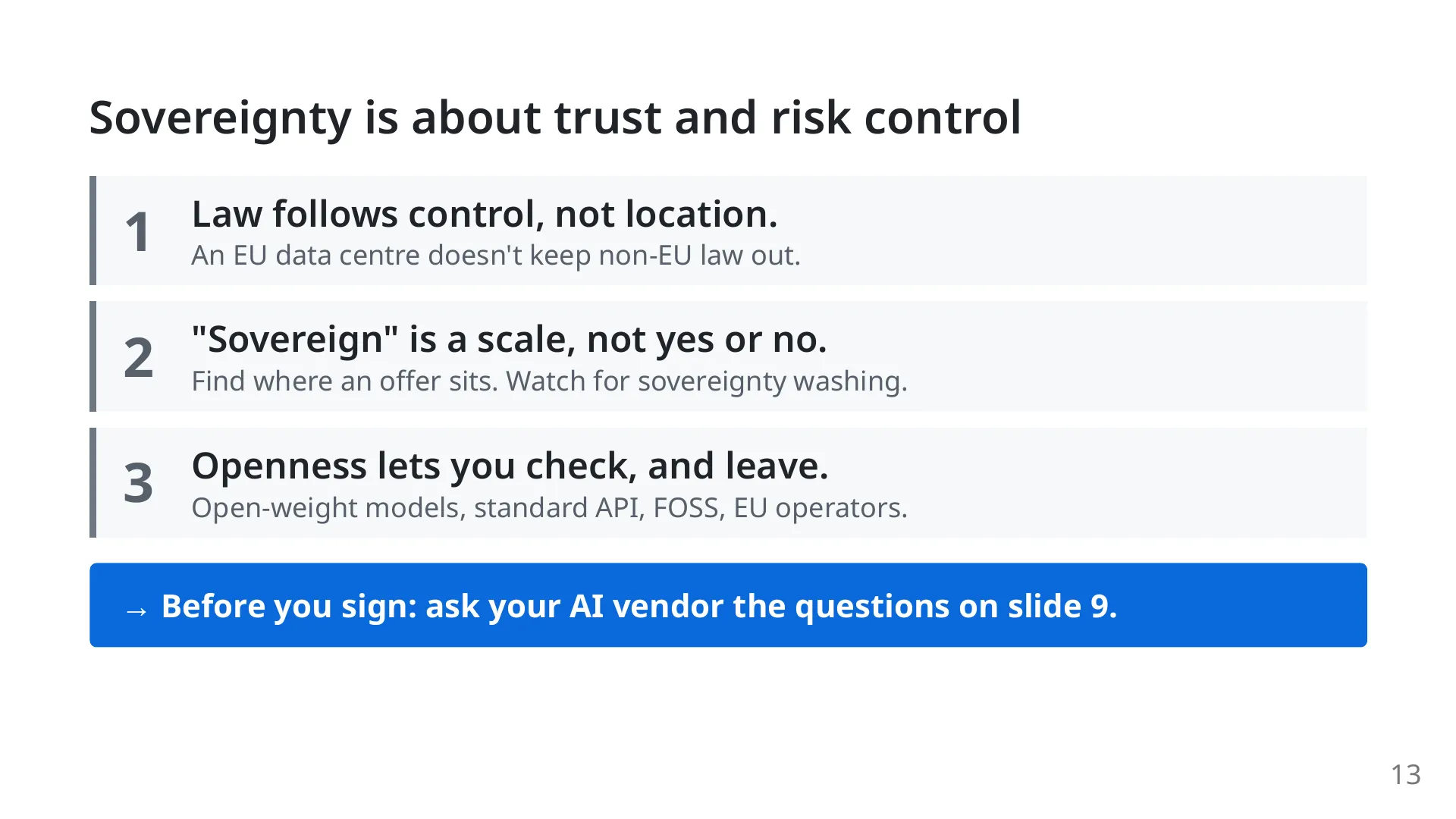
  1. 1

    Law follows control, not location.

    An EU data centre doesn't keep non-EU law out.

  2. 2

    "Sovereign" is a scale, not yes or no.

    Find where an offer sits. Watch for sovereignty washing.

  3. 3

    Openness lets you check, and leave.

    Open-weight models, standard API, FOSS, EU operators.

Ask your AI vendor

EU control

No hidden third parties

It keeps working

Your data stays yours

You can leave

🚩 Signs of sovereignty washing: “sovereign” with a non-EU parent · “hosted in the EU” only · non-EU fallback · proprietary API

Slides
  1. Slide 1: Generative AI in a Truly Sovereign Digital Europe A field guide to real sovereignty for LLMs Christian Gapp · lynq.ing · SFSCon 2026
  2. Slide 2: Who's talking Christian Gapp: developer, co-founder of lynq.ing We build an LLM-based product in South Tyrol and Austria, for EU customers What follows is what we found on the way, about LLMs (large language models, text). The same questions apply to image, audio and video generation.
  3. Slide 3: Not legal advice These are findings from building a product, not legal opinions. The market moves fast: anything here may be out of date by tomorrow. That's why no providers are named: check your own vendors yourself.
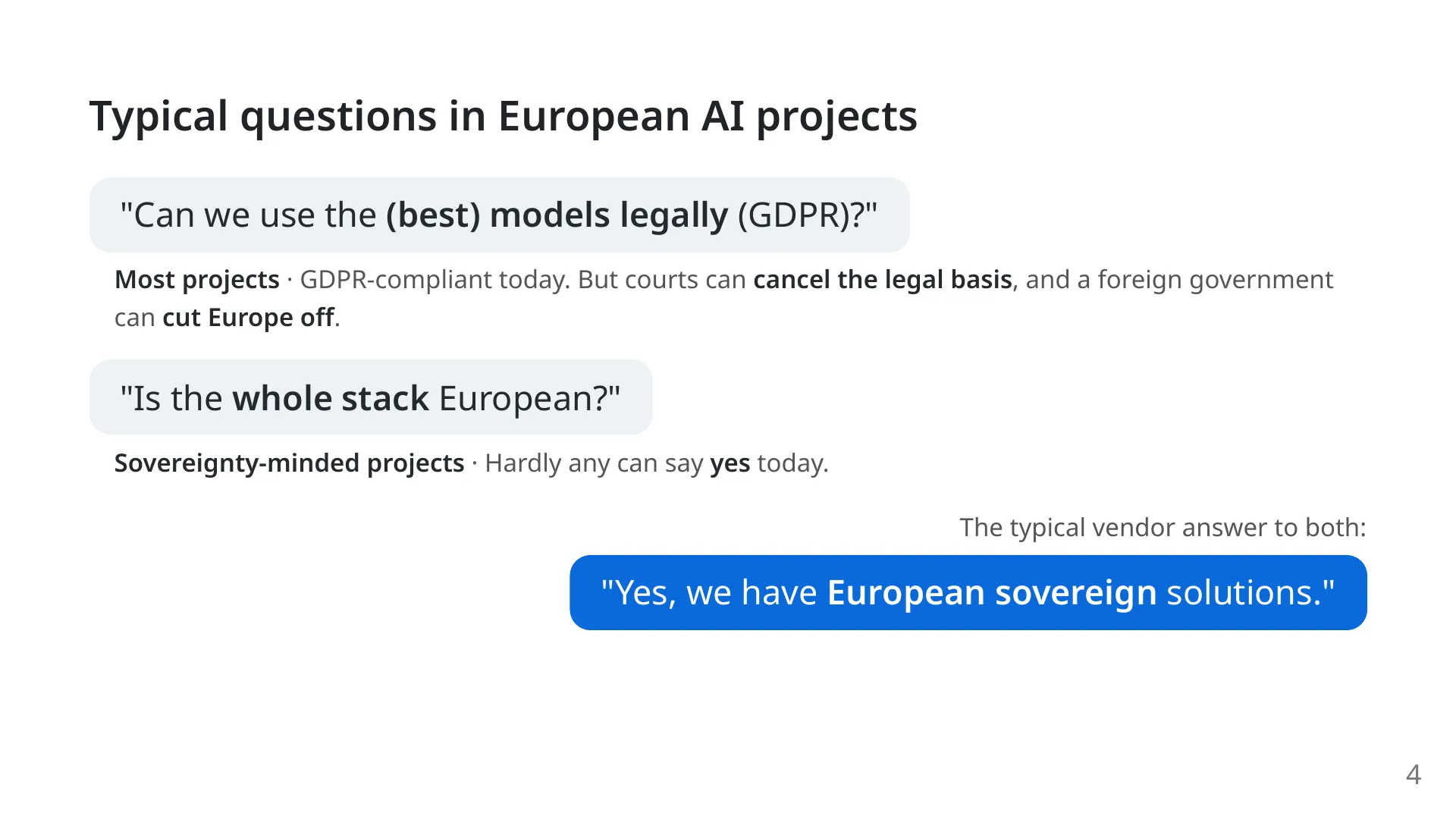
  4. Slide 4: Typical questions in European AI projects "Can we use the (best) models legally (GDPR)?" Most projects · GDPR-compliant today. But courts can cancel the legal basis, and a foreign government can cut Europe off. "Is the whole stack European?" Sovereignty-minded projects · Hardly any can say yes today. The typical vendor answer to both: "Yes, we have European sovereign solutions."
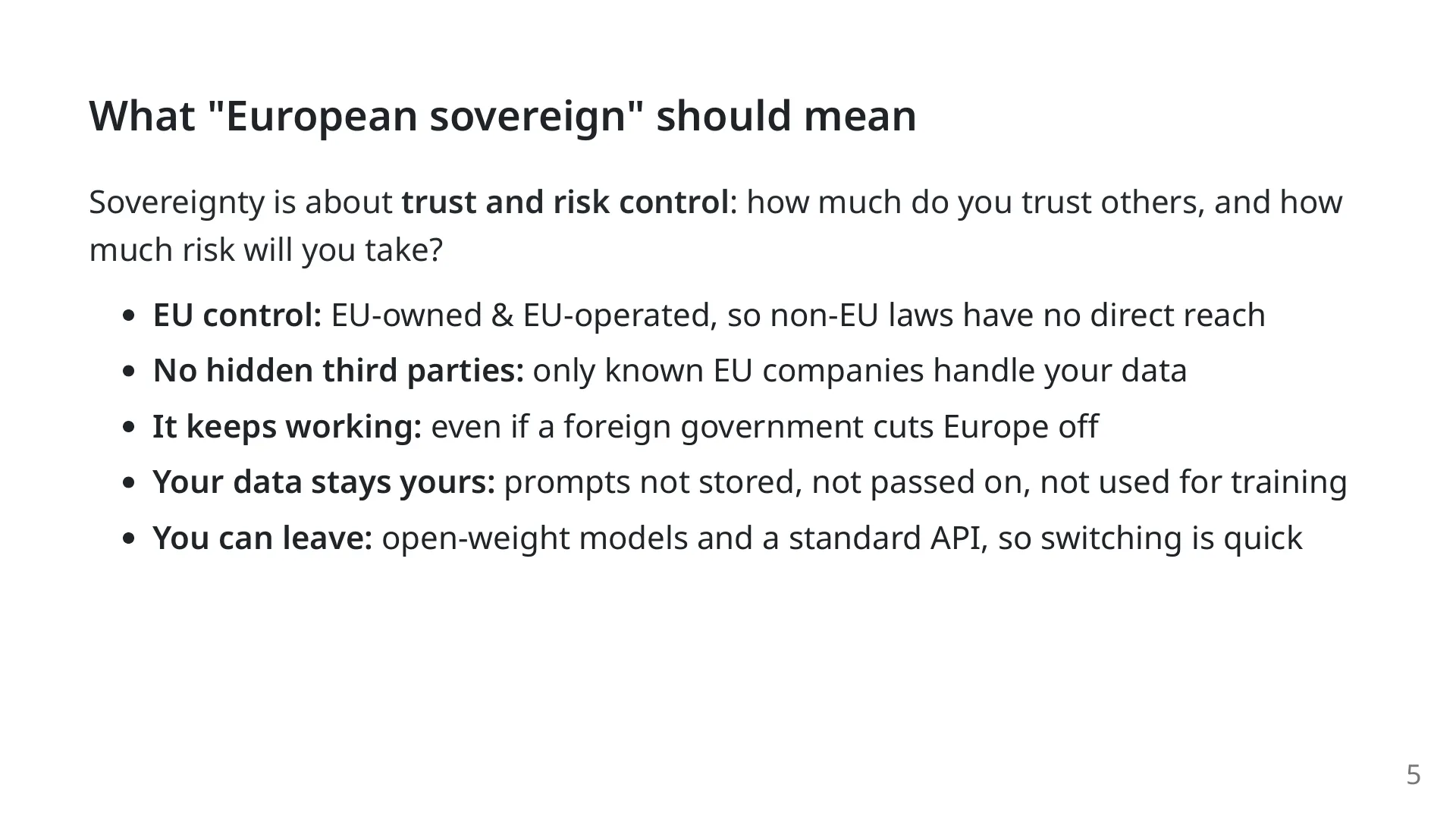
  5. Slide 5: What "European sovereign" should mean Sovereignty is about trust and risk control: how much do you trust others, and how much risk will you take? EU control: EU-owned & EU-operated, so non-EU laws have no direct reach No hidden third parties: only known EU companies handle your data It keeps working: even if a foreign government cuts Europe off Your data stays yours: prompts not stored, not passed on, not used for training You can leave: open-weight models and a standard API, so switching is quick
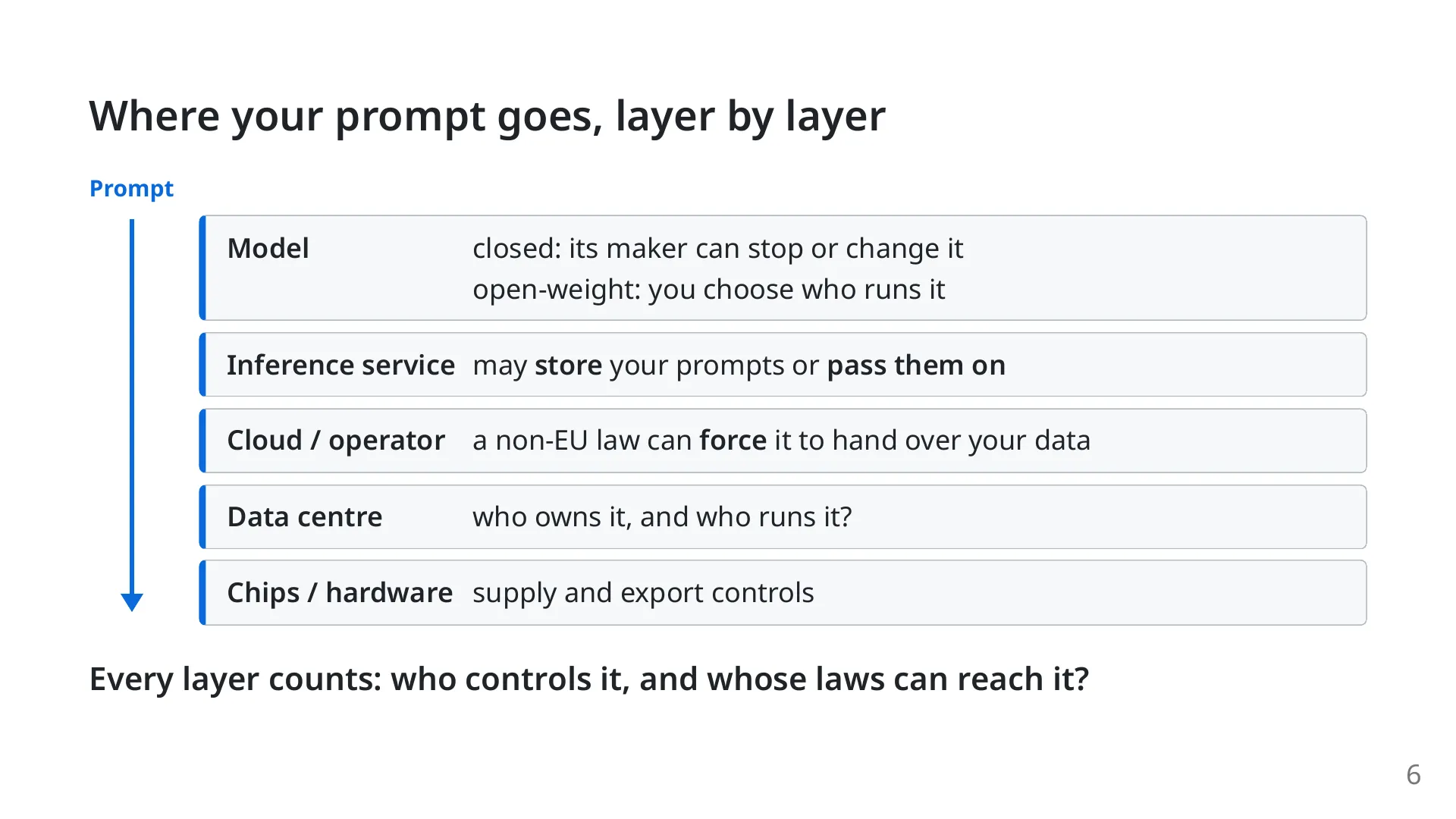
  6. Slide 6: Where your prompt goes, layer by layer Prompt Model closed: its maker can stop or change it open-weight: you choose who runs it Inference service may store your prompts or pass them on Cloud / operator a non-EU law can force it to hand over your data Data centre who owns it, and who runs it? Chips / hardware supply and export controls Every layer counts: who controls it, and whose laws can reach it?
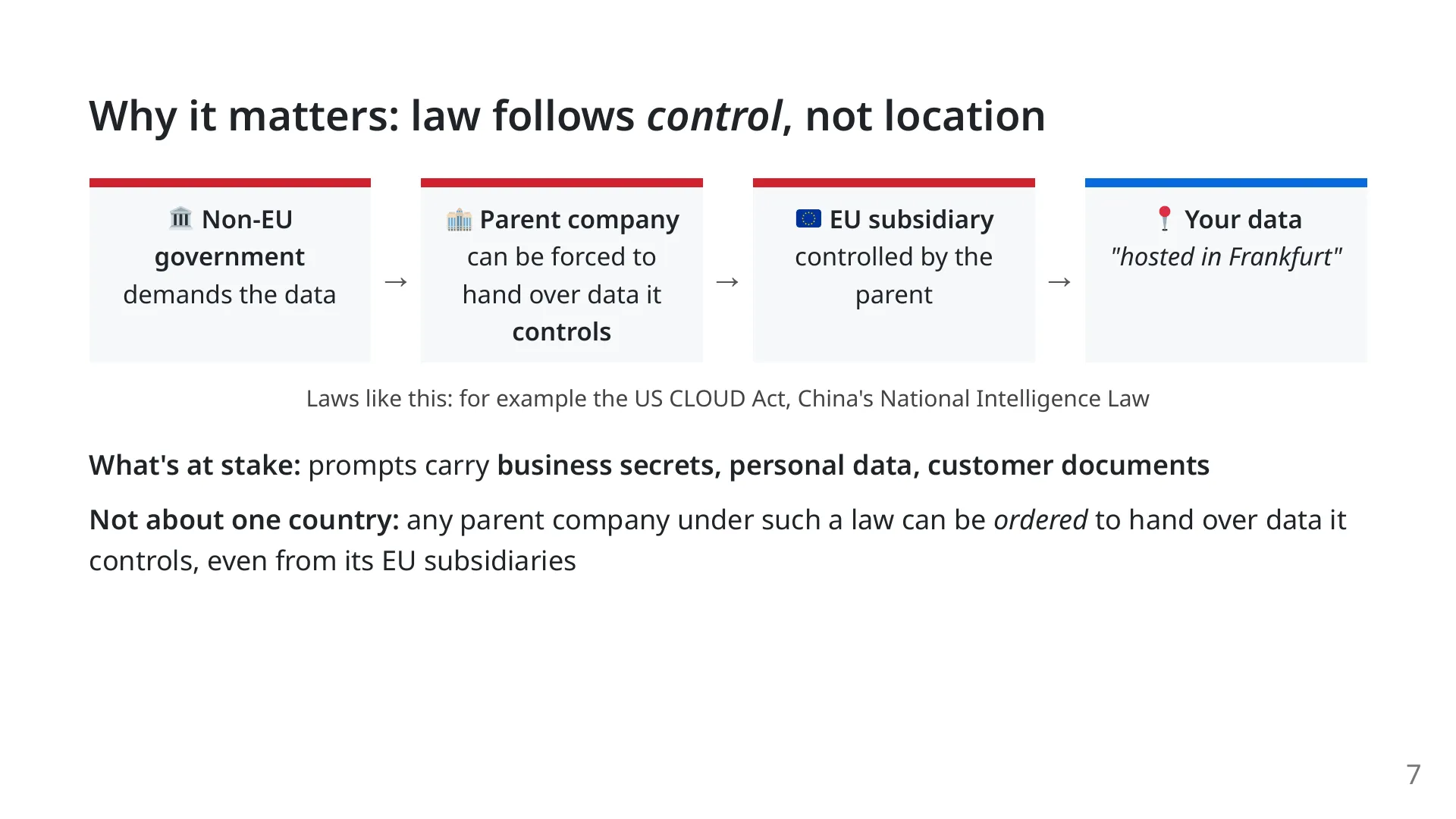
  7. Slide 7: Why it matters: law follows control, not location Non-EU Parent company government demands the data → can be forced to hand over data it controls EU subsidiary → controlled by the parent Your data → "hosted in Frankfurt" Laws like this: for example the US CLOUD Act, China's National Intelligence Law What's at stake: prompts carry business secrets, personal data, customer documents Not about one country: any parent company under such a law can be ordered to hand over data it controls, even from its EU subsidiaries
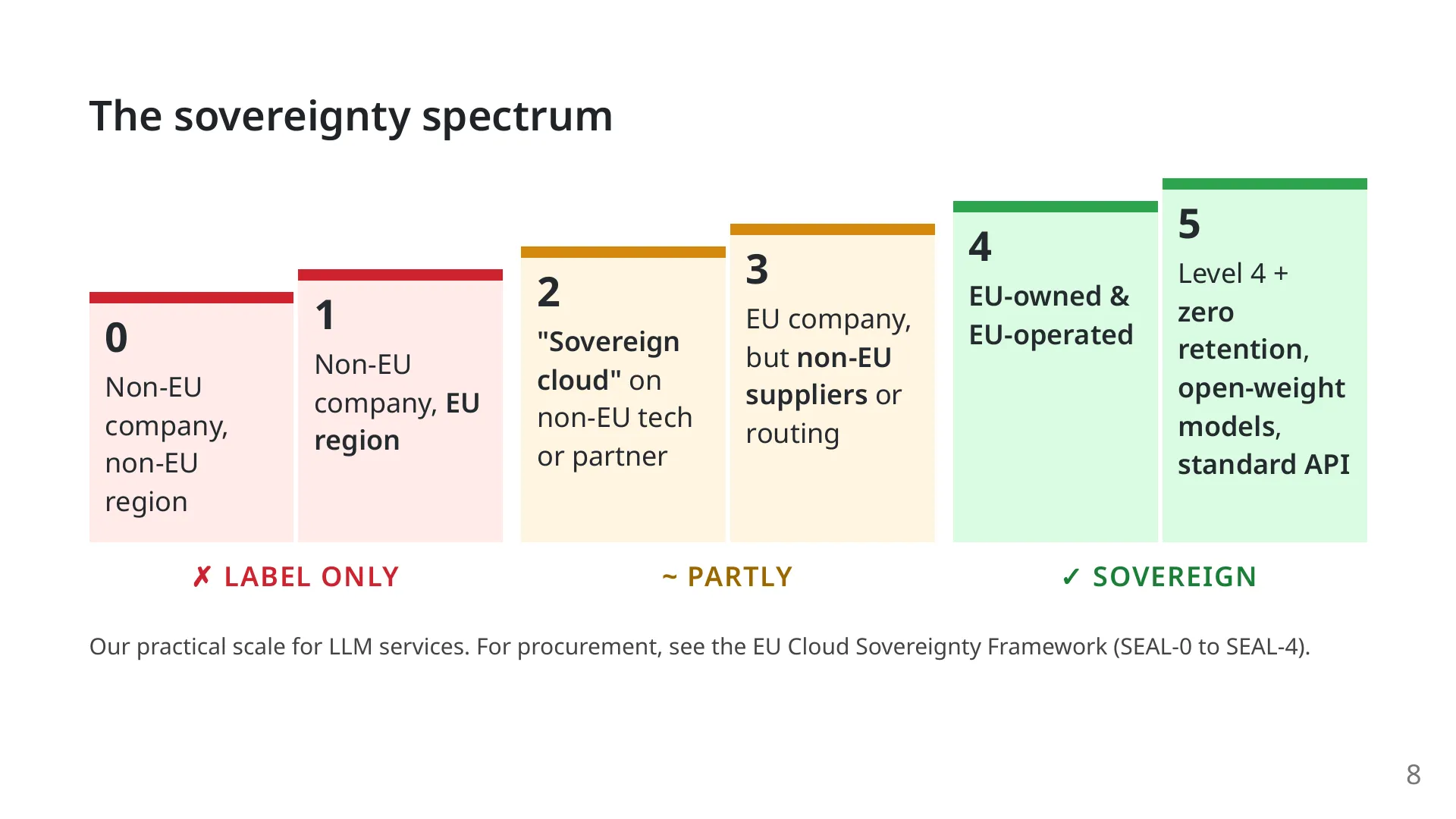
  8. Slide 8: The sovereignty spectrum 1 0 Non-EU company, non-EU region Non-EU company, EU region ✗ LABEL ONLY 3 2 "Sovereign cloud" on non-EU tech or partner EU company, but non-EU suppliers or routing ~ PARTLY 5 4 EU-owned & EU-operated Level 4 + zero retention, open‑weight models, standard API ✓ SOVEREIGN Our practical scale for LLM services. For procurement, see the EU Cloud Sovereignty Framework (SEAL-0 to SEAL-4).
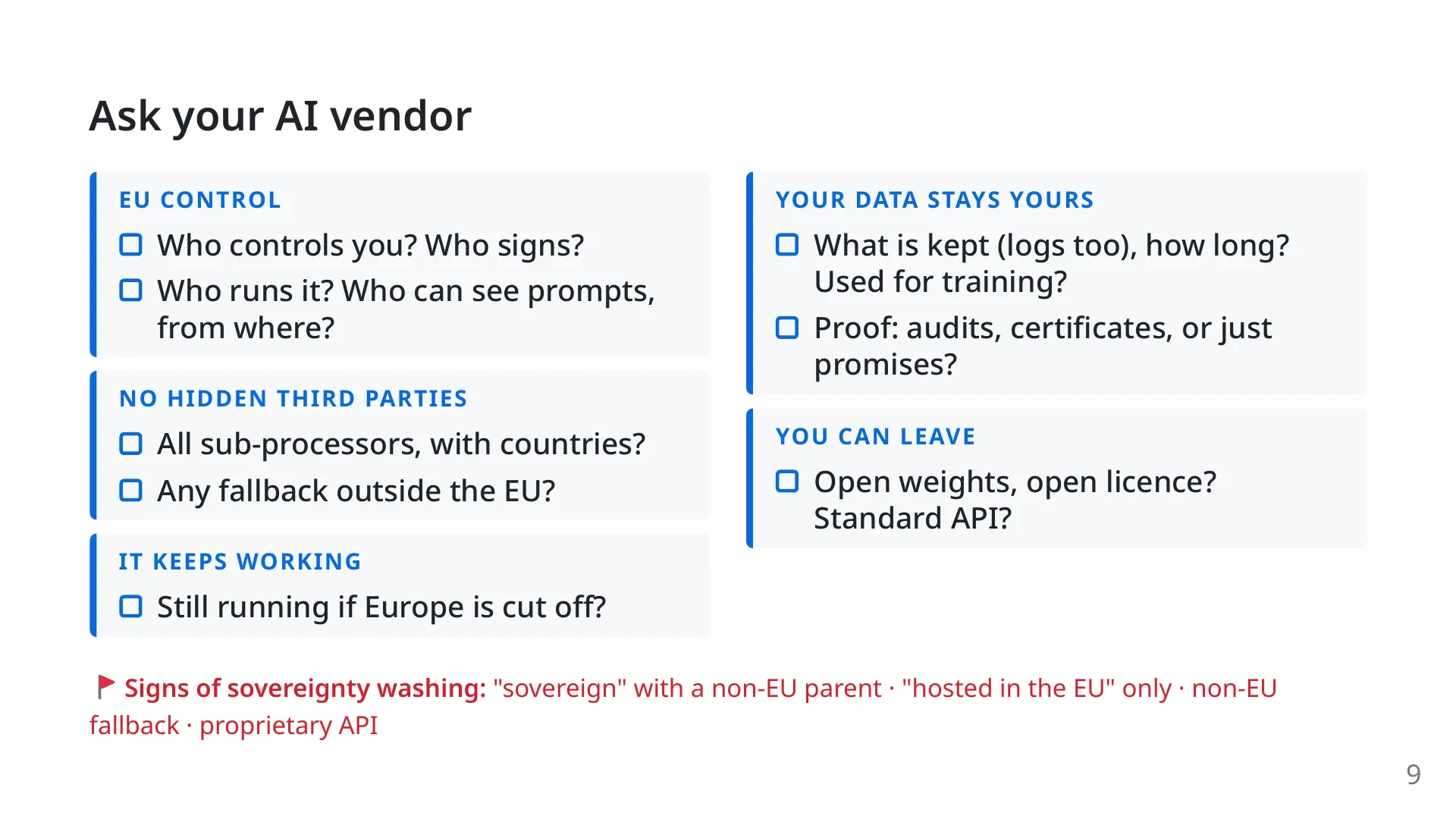
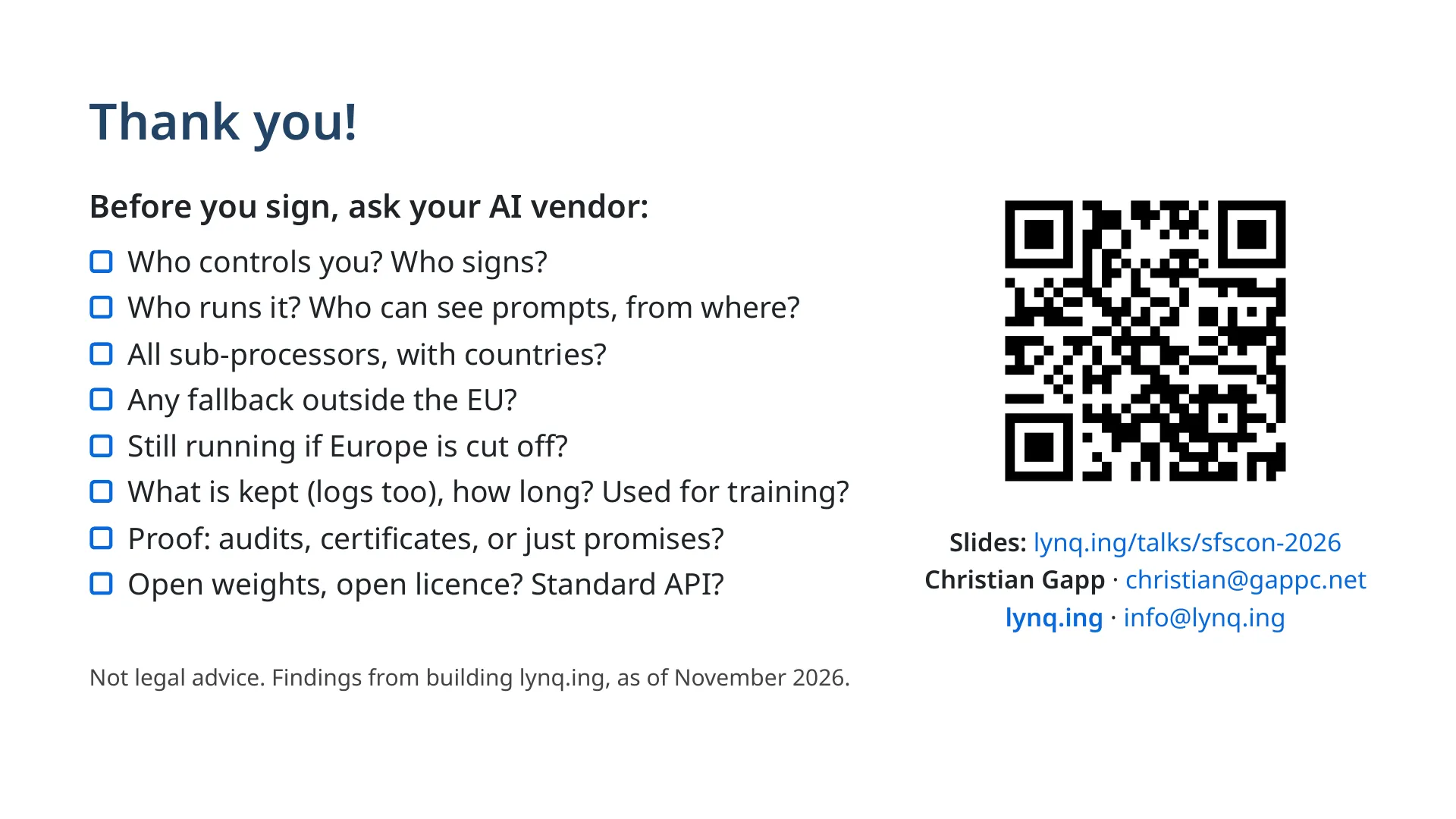
  9. Slide 9: Ask your AI vendor EU CONTROL Who controls you? Who signs? Who runs it? Who can see prompts, from where? NO HIDDEN THIRD PARTIES All sub-processors, with countries? Any fallback outside the EU? YOUR DATA STAYS YOURS What is kept (logs too), how long? Used for training? Proof: audits, certificates, or just promises? YOU CAN LEAVE Open weights, open licence? Standard API? IT KEEPS WORKING Still running if Europe is cut off? Signs of sovereignty washing: "sovereign" with a non-EU parent · "hosted in the EU" only · non-EU fallback · proprietary API
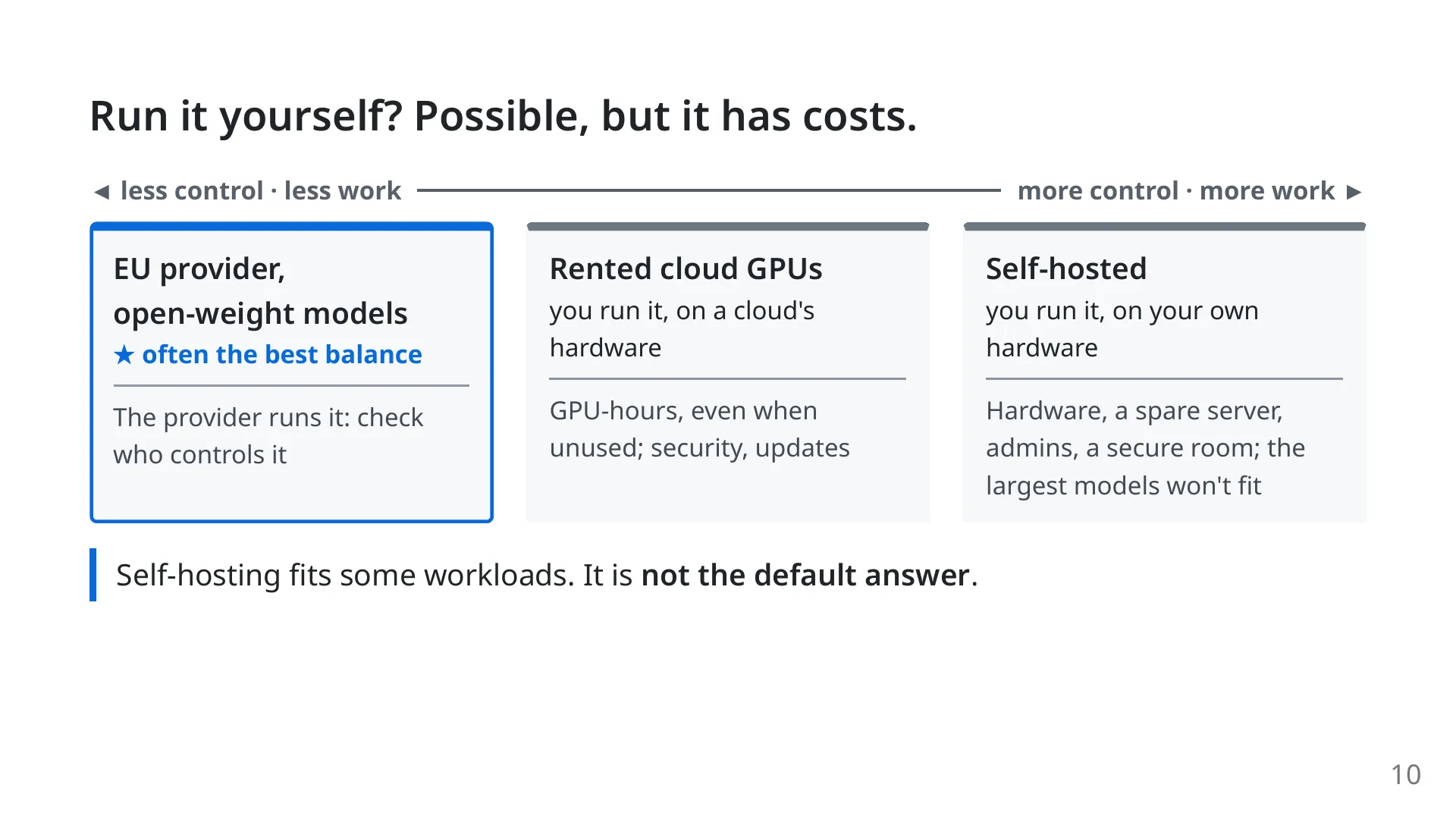
  10. Slide 10: Run it yourself? Possible, but it has costs. ◄ less control · less work more control · more work ► EU provider, open‑weight models ★ often the best balance Rented cloud GPUs Self-hosted you run it, on a cloud's you run it, on your own hardware hardware The provider runs it: check who controls it GPU-hours, even when unused; security, updates Hardware, a spare server, admins, a secure room; the largest models won't fit Self-hosting fits some workloads. It is not the default answer.
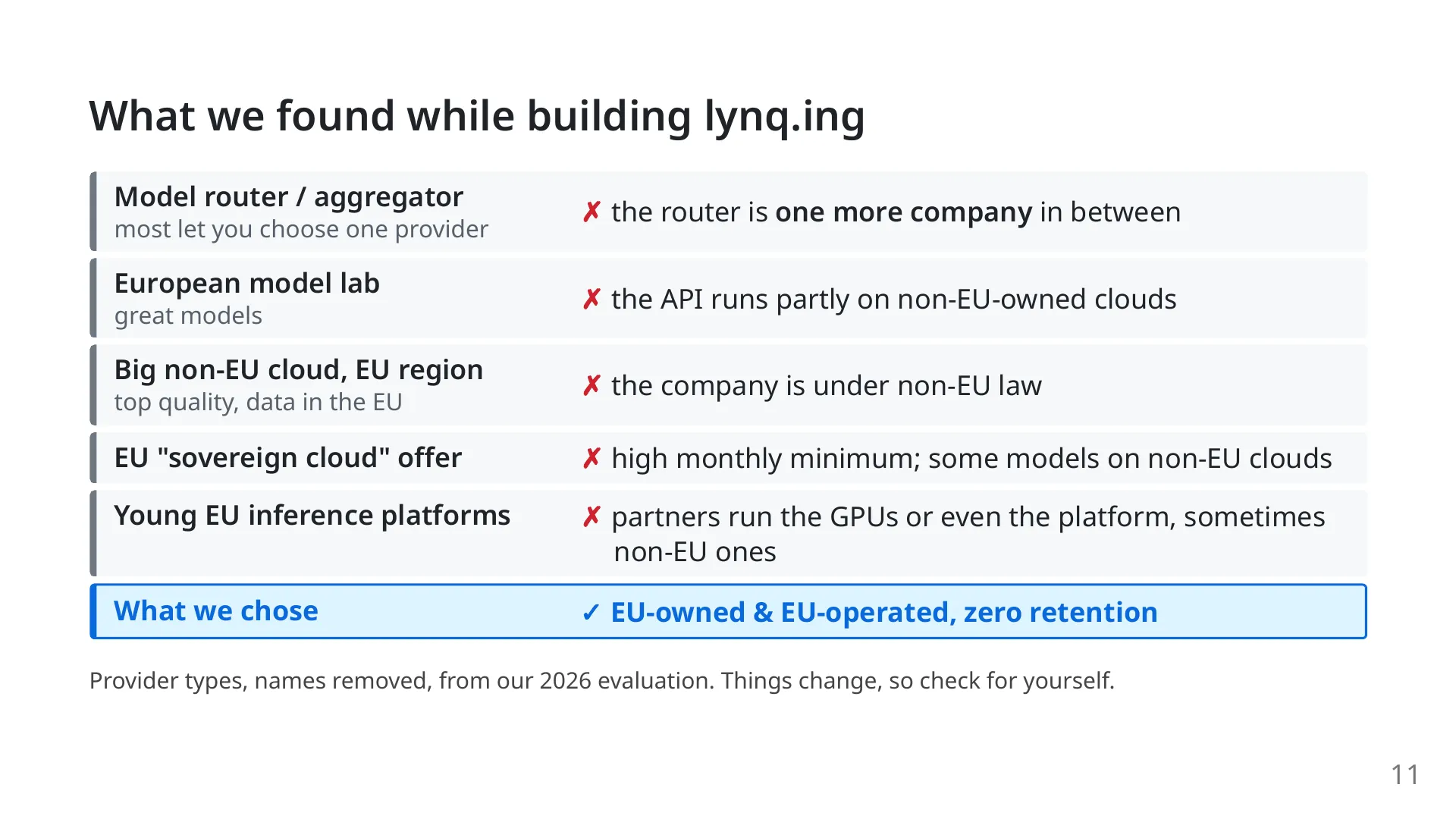
  11. Slide 11: What we found while building lynq.ing Model router / aggregator most let you choose one provider European model lab great models Big non-EU cloud, EU region ✗ the router is one more company in between ✗ the API runs partly on non-EU-owned clouds top quality, data in the EU ✗ the company is under non-EU law EU "sovereign cloud" offer ✗ high monthly minimum; some models on non-EU clouds Young EU inference platforms ✗ partners run the GPUs or even the platform, sometimes What we chose ✓ EU-owned & EU-operated, zero retention non-EU ones Provider types, names removed, from our 2026 evaluation. Things change, so check for yourself.
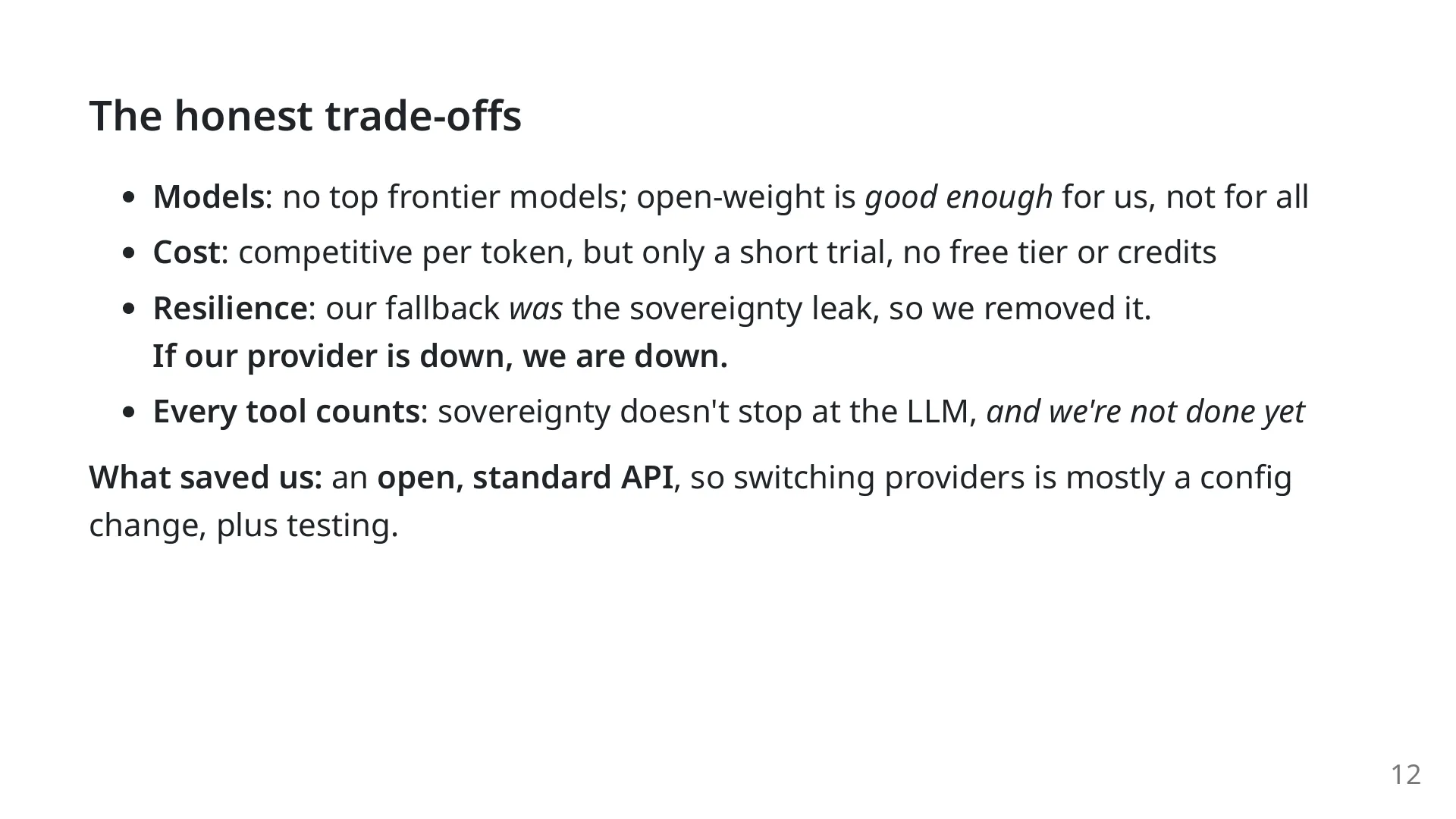
  12. Slide 12: The honest trade-offs Models: no top frontier models; open-weight is good enough for us, not for all Cost: competitive per token, but only a short trial, no free tier or credits Resilience: our fallback was the sovereignty leak, so we removed it. If our provider is down, we are down. Every tool counts: sovereignty doesn't stop at the LLM, and we're not done yet What saved us: an open, standard API, so switching providers is mostly a config change, plus testing.
  13. Slide 13: Sovereignty is about trust and risk control Law follows control, not location. 1 An EU data centre doesn't keep non-EU law out. "Sovereign" is a scale, not yes or no. 2 Find where an offer sits. Watch for sovereignty washing. Openness lets you check, and leave. 3 Open-weight models, standard API, FOSS, EU operators. → Before you sign: ask your AI vendor the questions on slide 9.
  14. Slide 14: Thank you! Before you sign, ask your AI vendor: Who controls you? Who signs? Who runs it? Who can see prompts, from where? All sub-processors, with countries? Any fallback outside the EU? Still running if Europe is cut off? What is kept (logs too), how long? Used for training? Proof: audits, certificates, or just promises? Open weights, open licence? Standard API? Not legal advice. Findings from building lynq.ing, as of November 2026. Slides: lynq.ing/talks/sfscon-2026 Christian Gapp · christian@gappc.net lynq.ing · info@lynq.ing

Not legal advice. Findings from building lynq.ing, as of November 2026.

About the speaker

Christian Gapp, developer and co-founder of lynq.ing. gappc.net

What is lynq?

lynq.ing watches how users interact with your platform, infers what they want, and rebuilds the experience for them in seconds. Learn more

Get on the list
Our waitlist is officially open. Leave your email to get early access to our complete personalization ecosystem.